

GMS Sri Lanka Scam? GridMind AI Investment Investigation
BLUF — High risk: do not invest or recruit others
HackAware assesses GMS in Sri Lanka as a suspected investment and recruitment scam: do not deposit money, buy earning units or recruit others. Its platform advertises 3% daily returns for 360 days (1,080% earnings), plus repayment of principal, alongside commissions across three generations and recruitment-dependent task bonuses, without independently verified commercial income supporting those obligations. The corporate-looking gmsdl.com directly promotes gmslk99.com and cannot independently validate it; its imagery, white paper, address and publicity do not establish asset ownership, paying AI customers or investment authorisation. Corporate identity, beneficial ownership, audited finances and the ultimate deposit beneficiary remain unverified. Together, these findings present serious Ponzi and pyramid indicators and justify a strong public warning, although the investigation has not traced payout funding or proved that GMS shares operators with AGM or another earlier scheme.
1. What GMS Sri Lanka / GridMind AI claims to be
GMS combines a public website describing an American AI-and-renewable-energy company with an account platform offering investments, tasks, purchases, referrals and team rewards.
The public website identifies the business as GridMind AI Systems Inc., founded in California in 2024. In-app history material claims an August 2024 founding, multiple self-owned power stations and an IPO ambition for mid-2027. These are platform claims, not verified facts. The login defaults to Sri Lanka’s +94 telephone code, registration includes an agent recruitment-code field and financial offers use Sri Lankan rupees. [1] [2] [3] [4]
| Website | Observed role | Evidentiary significance |
|---|---|---|
| gmsdl.com | Corporate story, images, white paper and recruitment buttons | Directly promotes the account platform |
| gmslk99.com | Login, financial offers, tasks and team rewards | Receives visitors from those buttons |
The corporate website is therefore part of the same promotional journey. It cannot independently corroborate the platform. The direct link establishes promotion, while legal ownership and the people controlling either domain remain unverified. [1] [2]
2. The central financial finding: 1,080% earnings
The Golden Desert Solar Plan, inspected under Energy Project, displays:
| Term | Advertised offer |
|---|---|
| Minimum investment | LKR 500 |
| Maximum investment | LKR 10,000,000 |
| Daily yield | 3% |
| Duration | 360 days |
| Total earnings rate | 1,080% |
| Principal | Described as returned after the cycle |
Its own example uses LKR 100,000 to promise LKR 3,000 daily and LKR 1,080,000 in earnings. Adding the separately promised capital implies LKR 1,180,000 total from LKR 100,000. [4]
| Contribution | Daily stated earnings | 360-day earnings | Total including principal |
|---|---|---|---|
| LKR 500 | LKR 15 | LKR 5,400 | LKR 5,900 |
| LKR 10,000 | LKR 300 | LKR 108,000 | LKR 118,000 |
| LKR 100,000 | LKR 3,000 | LKR 1,080,000 | LKR 1,180,000 |
| LKR 1,000,000 | LKR 30,000 | LKR 10,800,000 | LKR 11,800,000 |
These calculations apply the simple advertised rate to the original contribution. They do not assume compounding. A daily accrual rate does not establish daily withdrawability, and an internal account credit is not a bank payment.
Renewable energy and AI can generate genuine business income. That does not explain GMS’s offer. To substantiate it, the operator would need to connect identifiable assets and external customer receipts to investor liabilities, including capacity, metered generation, electricity buyers, realised prices, operating costs and audited cash flow.
The inspected material supplied no such reconciliation. For each LKR 100,000 contribution, the terms imply LKR 1,080,000 of earnings beyond repayment of capital. General references to expansion and asset management do not explain that obligation.
Investor.gov identifies exceptional or unusually consistent returns and opaque investment explanations as Ponzi warning signs. A conclusive Ponzi finding additionally requires evidence that later investors’ money pays earlier investors. That flow has not been traced here. [5]
3. Three generations of recruitment rewards
The Grow Tech Group rules state:
| GMS term | Relationship | Electricity-purchase commission | Training-reward subsidy |
|---|---|---|---|
| Core Node | Direct recruits | 15% | 3% |
| Level 1 Node | Recruits of direct recruits | 2% | 2% |
| Level 2 Node | Next generation | 1% | 1% |
These are observed compensation terms, not estimates. Where all qualifying generations apply, the purchase percentages total 18% and training subsidies total 6%. These totals describe the schedule, not verified payouts. [4]
The rules refer to electricity purchases and training rewards. HackAware has not established that these commissions also apply to the solar investment.
The economic question is whether independently paying customers outside the earning network support these rewards, or whether participant spending supplies the underlying money. The investigation did not establish sufficient external demand or revenue.
Calling recruits “nodes” and commissions “guidance subsidies” does not change their function: participants are encouraged financially to expand a downline.
What do the generation payments cost in actual money?
Suppose a member makes an eligible LKR 1,000 electricity purchase, and all three upstream levels qualify:
| Recipient | Stated percentage | Payment |
|---|---|---|
| Direct recruiter | 15% | LKR 150 |
| Recruiter’s recruiter | 2% | LKR 20 |
| Third upstream recipient | 1% | LKR 10 |
| Total upstream commissions | 18% | LKR 180 |
| Amount left from the purchase before other costs | 82% | LKR 820 |
The LKR 180 is a combined commission on this hypothetical purchase, not a verified fixed payment per person or per task. A LKR 10,000 eligible purchase would imply LKR 1,800 across those levels. These are calculations from the displayed rules, not evidence of actual payouts.
Separately, if a participant earns LKR 1,000 in qualifying training rewards, the stated 3%, 2% and 1% subsidies imply LKR 60 to upstream members, in addition to that participant’s LKR 1,000 reward. Whether every payment is made and which conditions apply remain unverified. Do not add the 18% schedule to the solar plan: its applicability to that product has not been established.
Could a genuine company pay an 18% sales commission? Yes. The percentage alone does not prove fraud. A business with sufficient product margin can budget commissions as a customer-acquisition expense. The essential questions are what genuine value the buyer receives, whether outside customers want it and whether customer revenue covers commissions, delivery, wages, infrastructure and other obligations.
For example, a hypothetical service selling for LKR 1,000 with LKR 600 in delivery costs and LKR 180 in commissions leaves LKR 220 before remaining overhead and taxes. If delivery costs were LKR 900, the same sale would lose LKR 80 before overhead. These are teaching examples, not GMS cost estimates. New participant money can temporarily cover a shortfall, but that would not demonstrate a self-supporting business.
Reality check: Alphabet/Google and Tesla
These companies are useful because Alphabet operates major AI/cloud businesses and Tesla sells energy products as well as vehicles. Their published results identify commercial receipts and expenses rather than merely asserting that a fashionable industry generates money. [15] [16]
| Full-year 2025 measure | Alphabet (Google’s parent) | Tesla |
|---|---|---|
| Revenue | USD 402.836 billion | USD 94.827 billion |
| Profit measure used here | USD 129.039 billion operating income | USD 3.794 billion net income attributable to common shareholders |
| That profit measure divided by revenue | Approximately 32.0% | Approximately 4.0% |
| Examples of customer-funded business | Advertising, cloud and subscriptions | Vehicles, energy generation/storage and services |
Alphabet figures come from its published 2025 earnings release; Tesla figures come from its 2025 Form 10-K. The profit definitions differ, so these percentages are not a ranking of like-for-like profitability. They illustrate that substantial sales still have substantial costs.
Neither margin is an investor return, a commission ceiling or a promise of what shareholders earn. It would be misleading to compare either percentage directly with GMS’s 1,080% return on contributed capital. A company’s profit margin measures profit relative to sales; an investment yield measures returns relative to invested money.
The valid comparison is accountability: identifiable customers, reported revenue, costs and financial statements allow a reader to examine how payments are funded. GMS’s inspected material does not supply an equivalent reconciliation for its promised rewards.
A household-scale test of the solar promise
Imagine 100 people each contribute LKR 100,000 to the advertised solar plan. This is a hypothetical scenario, not an estimate of actual participants.
| Obligation under the stated terms | Amount |
|---|---|
| Initial contributions | LKR 10,000,000 |
| Combined daily earnings at 3% | LKR 300,000 |
| Thirty days of earnings | LKR 9,000,000 |
| Earnings over 360 days | LKR 108,000,000 |
| Principal plus full-cycle earnings | LKR 118,000,000 |
In 30 days, the promised earnings alone equal 90% of the initial pool. Over the full cycle, the operator must meet LKR 108 million in earnings beyond returning the original LKR 10 million, before considering its other business costs. Daily earnings here describe accrual; actual withdrawal timing remains unverified.
A responsible explanation must show the external receipts or other sustainable funding that meet these obligations. Even a well-known AI or energy business does not make this arithmetic disappear. If payments instead depend on continually attracting new participants, the model cannot support everyone indefinitely. This investigation has not traced GMS’s actual payout funding.
Red flags established by this investigation
- Extreme return promise: 3% daily and 1,080% earnings over 360 days.
- Unexplained funding: no verified commercial reconciliation for the promised liabilities.
- Recruitment incentives: three upstream commission levels and a recruitment-conditioned bonus.
- Unverified AI economics: no established paying customer or revenue attributable to the inspected tasks.
- Unverified accountability: no validated contracting entity, beneficial ownership or financial authorisation obtained.
- Promotional credibility loop: the corporate site directly funnels visitors into the offer.
- Weak operational substantiation: conceptual imagery, template residue and no verified asset inventory.
- Unresolved money trail: ultimate deposit beneficiary and actual withdrawal performance remain unknown.
Some items are observed terms; others are disclosed evidence gaps. They must not be misrepresented as separate proven offences. Their combined significance supports the do-not-invest warning.
4. The bonus requires recruiting people
The first inspected task-reward tier requires six Core Node members and 1,200 AI-training tasks within 30 days, for LKR 30,000. Recruitment is therefore an explicit eligibility condition, regardless of the tasks’ possible commercial value. [4]
| Tier | Displayed reward | Member requirement | Task requirement |
|---|---|---|---|
| 1 | 30,000 | 6 | 1,200 |
| 5 | 83,000 | 30 | 6,000 |
| 10 | 450,000 | 300 | 67,500 |
| 15 | 2,500,000 | 3,000 | 600,000 |
| 18 | 9,000,000 | 20,000 | 4,500,000 |
LKR was explicitly verified in the first tier’s detailed rules. Higher figures are displayed amounts; every later-tier detailed rule was not separately inspected. Identical membership definitions across tiers must not be assumed.
The first-tier rules also restrict the task contribution of mini members and allow higher membership categories to substitute. Despite the monthly presentation, the inspected rules say each level can be claimed and completed once before progression. They do not establish a permanent monthly salary.
5. Does the AI interface demonstrate a real business?
The AI section contains earning counters, question counters and a Buy Units option. The inspected account’s purchase page showed no available purchase options and no rules available. This may be account-dependent or temporary; it does not establish that packages never exist. [4]
No paid task was performed. Package prices, units-to-money conversion, paying AI customers, ownership of outputs and measurable model improvements remain unverified.
A functioning-looking interface is not evidence of productive work. The operator must explain what participants produce, who purchases it and how customer payments support compensation.
The FTC describes task scams in which apparent earnings build confidence before participants must deposit money. GMS’s task-and-purchase presentation warrants comparison, but this investigation did not verify a GMS demand to pay extra money to release a withdrawal or establish every stage of that pattern. [6]
6. Corporate identity and the American address
HackAware did not obtain a validated incorporation record for the entity behind the offer. California’s official search service blocked the investigation browser. That is an unresolved check, not a registry finding that the company does not exist. [7]
| Fundamental question | Finding |
|---|---|
| Verified incorporation and filing number | Not obtained |
| Directors and beneficial owners | Not verified |
| Contracting entity for Sri Lankan participants | Not established |
| Authority or legal basis for the investment offer | Not verified |
| Audited accounts supporting returns | Not obtained |
| Ownership of energy assets | Not established |
| Impersonation of a specific genuine company | Not established |
Even a later-confirmed incorporation would not establish investment authorisation, asset ownership or solvency.
GMS lists 445 S Figueroa St, Los Angeles, CA 90071. Earlier checks identified a real multi-tenant office tower and office-provider references to that address. GMS occupancy, suite, personnel and equipment were not verified. [2] [8]
A real address does not authenticate a headquarters. Equally, serviced offices are normal business facilities. The finding is unverified occupancy, not a proven fake address.
The absence of verified information alone does not prove fraud. Here it accompanies extraordinary return promises and recruitment incentives. That combination supports the warning.
7. Imagery: promotion rather than asset evidence

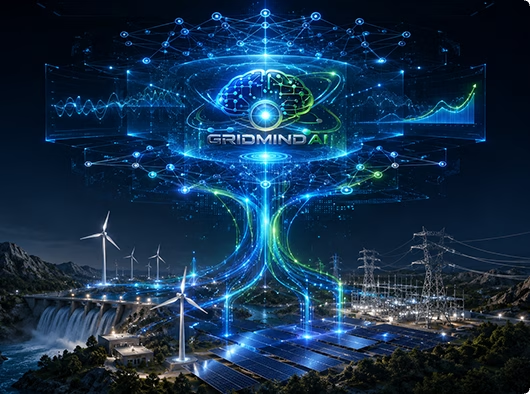
The site uses futuristic energy landscapes, glowing networks, a brain floating above Earth and branded scenes combining dams, solar panels and turbines.
| Image | Finding and source |
|---|---|
|
Conceptual brain/Earth/energy scene |
|
Branded conceptual infrastructure |
 |
Control-room-style visual; authenticity unverified |
 |
Infrastructure image labelled as a team image in homepage HTML |
Image copies are hosted by HackAware. Original source paths are shown for provenance; promotional imagery does not establish asset ownership.
Several images appear synthetic or heavily composited. Appearance alone cannot conclusively prove AI generation. More firmly, they do not establish ownership of identifiable infrastructure or operation of a real product.
Earlier examination recorded Adobe Photoshop 26.0 metadata in selected originals:
| Asset | Recorded timestamp |
|---|---|
| Project image 2 | 30 May 2026, 17:08:26 +08:00 |
| Image labelled as the team | 30 May 2026, 17:00:36 +08:00 |
| Selected testimonial portrait | 30 May 2026, 17:10:46 +08:00 |
Metadata is editable. It does not authenticate creation time, identify the editor or establish their country. The timezone must not be used for nationality attribution. No conclusive reverse-image original was established, and portraits have not been proved fictitious.
8. Template residue and undocumented projects
The About page retains a vision section naming TechXen, a commercial website template. Template use is ordinary; leaving another brand’s narrative in place undermines the page as evidence of GMS’s specific history. No connection between the template author and the scheme is alleged. [2] [9]
Inspected project cards lead to placeholders rather than records identifying customers, locations, commissioning dates or results. Carousel repeats are not additional projects.
The About page displays wind, solar and hydropower percentages without explaining their measurement. They cannot be treated as verified capacity or performance statistics. Testimonials likewise do not supply independently authenticated partner evidence. [1] [2]
9. White paper, IPO claim and paid publicity
Read or download the GridMind AI White Paper (PDF, hosted by HackAware) · Original GMS source. This company-published document is reproduced for analysis; its claims are not independently endorsed.
The previously examined white paper is 39 pages. It discusses energy and AI but supplied no named plant inventory, generating-capacity table, identifiable electricity buyers, audited accounts or numerical model-validation results. It did not reconcile the return promise and recruitment costs with external revenue. [3]
Its file properties record WPS processing and May 2026 dates. Those editable properties do not establish authorship or nationality.
An IPO ambition is not an exchange admission or approved offering. No verified underwriter commitment or exchange process was established.
Located publicity includes syndicated press releases. StreetInsider labels the identified release paid content and states its newsroom was not involved. Paid publicity is not itself fraud, but republication does not independently validate company claims. [10]
The credibility loop is circular: the platform makes claims, its corporate site repeats them, publicity distributes them and the corporate site directs visitors back into the platform. Repetition is not corroboration.
10. Technical timeline
The earlier technical review retrieved Verisign registry responses and certificate-transparency records on 23 October 2026. [11] [12]
| Date | Event | Status |
|---|---|---|
| August 2024 | Company founding | GMS claim |
| 30 January 2026 | Current gmsdl.com registration event | Registry record |
| 12 May 2026 | White-paper dates | Editable properties |
| 30 May 2026 | Selected image dates | Editable properties |
| 2 June 2026 | gmslk99.com registration | Registry record |
| 1 August 2026 | Located press releases | Publication date |
| 23 October 2026 | Investigation | Observation date |
Older certificates exist for gmsdl.com. The domain must not be described as first existing in 2026. No continuity between historical users and the present operation was established.
Both domains used Gname as registrar in the recorded responses. The platform used Cloudflare front-end infrastructure. Shared providers do not identify operators or connect unrelated schemes; CDN addresses do not establish an origin-server location.
The application-bundle download was blocked, an archive lookup timed out and no APK was obtained or executed. This report therefore makes no malware finding or complete application-code attribution.
11. A familiar mechanism does not prove a common operator
The concern about a recurring scheme is understandable: a fashionable industry narrative accompanies participant payments, earning interfaces, extreme returns and recruitment rewards.
| Comparison | GMS evidence | Boundary |
|---|---|---|
| Ponzi indicators | Extreme returns; unverified revenue backing | Payout funding not traced |
| Pyramid indicators | Multi-generation purchase rewards; recruitment-conditioned bonus | No GMS-specific legal determination |
| Task-scam indicators | Task counters and unit-purchase interface | Full paid journey not tested |
| Rebrand of an earlier operation | Similar mechanisms | Common ownership/control not established |
CBSL’s guidance provides a relevant framework for examining benefits linked to expanding participation or contributions. It is not evidence of a regulator determination naming GMS. [13]
HackAware does not currently assert that GMS is AGM renamed. Shared beneficiaries, migration notices, demonstrably shared administration or other corroborated control links would be needed. Similarity supports scrutiny, not completed attribution.
12. GMS deposits, payments and withdrawals
The recharge page displayed three generically named channels and a stated range of LKR 50–10,000,000. No recharge was submitted, so the ultimate merchant, bank account and beneficiary remain unidentified. [4]
Withdrawal access required configuring a separate password. The investigator did not change the account. Live limits, fees and actual payout performance remain unverified. A tutorial bank illustration does not demonstrate a partnership or completed payment.
No independently verified withdrawal failure is alleged. A balance on a screen is not proof that money is held for the user.
A documented successful withdrawal would establish that payment. It would not establish the source of funds or the ability to meet all liabilities.
13. What would substantiate the offer?
GMS would need to provide independently checkable evidence of:
- Legal identity, ownership, directors and the entity responsible for participant contracts.
- The authority or legal basis for offering the financial product.
- Identified power assets, ownership, capacity, output and electricity-sale contracts.
- Audited external receipts reconciled against investor liabilities and recruitment costs.
- Real AI customers, useful deliverables and commercial revenue.
- Legal payment beneficiaries, complete withdrawal terms and bank-reconciled records.
These questions have not been formally sent to the operator. No refusal to respond is implied. Substantive evidence should be assessed and material corrections published openly.
14. What readers should do
Do not fund this offer or recruit others. Do not borrow or use emergency savings to test it.
If already involved, preserve original recruitment messages, plan terms, receipts, beneficiary names, bank references and withdrawal requests with dates. Keep originals and redact personal information before public sharing.
Do not pay further purported taxes, verification charges, security deposits or recovery fees merely because someone says they will unlock earnings. Avoid supplying additional identity documents or installing unknown software to recover a balance.
Use official police or regulator websites to obtain current reporting channels. Preserve evidence before accounts or groups disappear. No complaint has been submitted on a participant’s behalf by this investigation.
15. Methodology and verdict
This article draws on the authenticated observations and public technical investigation recorded on 23 October 2026. The corporate homepage and About page were rechecked for this publication version. Earlier technical findings are identified as such; not every original file or authenticated screen was retrieved a second time.
No deposit, purchase, withdrawal, recruitment or paid task was performed. No authentication bypass or intrusive testing occurred. No operator was contacted. No independently verified victim loss or judicial finding is asserted.
GMS presents a suspected investment and recruitment scam with serious Ponzi and pyramid indicators. Do not invest. The 1,080% earnings promise, recruitment-linked compensation and absence of independently verified commercial backing form the basis of this assessment.
The warning is firm. A proved Ponzi cash flow, fictitious incorporation and confirmed rebrand by the same operators remain separate, unestablished claims.
GMS Sri Lanka scam questions: investment, app and withdrawals
Is GMS Sri Lanka a scam or a legitimate investment?
HackAware assesses GMS as a suspected investment and recruitment scam and advises readers not to invest or recruit others. The GMS Sri Lanka offer combines a 3% daily return promise with recruitment-linked rewards, without independently verified commercial revenue supporting those obligations. This is an evidence-based risk assessment, not a court finding or a GMS-specific regulator ruling.
What are GMS, GridMind AI and gmslk99.com?
The platform at gmslk99.com presents investment plans, AI tasks and team rewards to users in Sri Lanka. The corporate website gmsdl.com uses the name GridMind AI Systems Inc. and directly promotes that platform. Its corporate story does not independently establish investment legitimacy, asset ownership or authorisation.
How does the GMS investment plan claim to pay 3% daily?
The inspected Golden Desert Solar Plan advertises 3% daily earnings for 360 days, equivalent to 1,080% of the contribution in earnings, plus repayment of principal. The investigation did not obtain an independently verified cash-flow explanation showing how external energy or AI customers fund that promise. Displayed earnings are not proof of money available for withdrawal.
Are GMS withdrawals and payments verified?
HackAware did not make a deposit or withdrawal and has not independently verified GMS withdrawal performance, fees or payment beneficiaries. This report does not claim that every withdrawal fails. Even a successful payment would not establish its funding source or prove that the scheme can meet all participants’ liabilities. Preserve receipts and withdrawal requests, and do not pay additional purported release fees solely on an operator’s promise.
Is the GMS app safe, and is GMS the same as AGM?
No APK was obtained or executed, so this investigation does not certify the GMS app as safe or make a malware finding. Similarities with AGM and other task-investment schemes warrant scrutiny, but common ownership or control has not been established. The article distinguishes recurring scam indicators from proof of a rebrand.
Sources
Self-published sources establish GMS’s representations, not their truth. Authenticated pages may change or require login.
- Corporate homepage.
- About page.
- White paper — HackAware-hosted PDF (original GMS source).
- Account platform: observed routes /earn_money, /invite, /member_position, /AIQuestion, /buy-power, /recharge, /help and /company_profile.
- Investor.gov: Ponzi schemes.
- FTC: How to spot and avoid task scams.
- California official business search: attempted lookup blocked, no outcome established.
- Downtown LA: Union Bank Plaza.
- TechXen template.
- StreetInsider paid release.
- Verisign RDAP: gmsdl.com, gmslk99.com.
- Certificate transparency: gmsdl.com, gmslk99.com.
- CBSL pyramid information and FAQs. General context, not a GMS-specific ruling.
Published 23 October 2026. Search metadata, headings and a reader FAQ updated 24 October 2026; the investigation’s evidentiary findings remain unchanged. Material updates and corrections will be dated.


