
Solar Max in Sri Lanka: Inside the “Solar Rental” Scheme Built to Collapse
At first glance, Solar Max looks like a modern renewable-energy opportunity. The branding is clean. The language feels professional. Solar panels, green energy, global projects, and steady income dominate the visuals.
But when you slow down and examine the system the way a consumer should — not as someone chasing fast returns, but as someone trying to protect their money — the reality becomes clear.
Solar Max is not a solar investment platform.
It is a short-term, high-return deposit scheme using Ponzi-style payment mechanics, disguised as a “solar panel rental” business.
This article explains how Solar Max works, why its promises are impossible, how recruitment plays a dangerous role, and why even those who “profit early” are helping cause wider harm.
How Solar Max Presents Itself

Solar Max claims users can earn income by renting solar panels for a fixed period, usually 30 days. The idea is deliberately simple:
You deposit money.
Solar Max “uses” solar panels.
You earn daily income.
At the end of 30 days, you receive a large payout.
There is no discussion of:
- Electricity tariffs
- Grid connections
- Weather variability
- Maintenance costs
- Depreciation
- Licensing or regulation
These are unavoidable realities in real solar projects — yet Solar Max bypasses all of them.
Instead, it focuses entirely on guaranteed numbers.
The Core Promise: Fixed Returns in 30 Days
Inside the “Rental Hall,” users are shown multiple packages labeled as solar panels. Each follows the same structure:
- Fixed deposit
- Fixed daily income
- Fixed 30-day duration
- Fixed total return


Examples taken directly from the platform include:
- LKR 1,000 → Total income LKR 3,600
- LKR 2,000 → Total income LKR 7,410
- LKR 10,000 → Total income LKR 39,150
- LKR 200,000 → Total income LKR 883,650
- LKR 2,000,000 → Total income LKR 9,787,950
All within 30 days.
That translates to 300%–400% monthly returns.
No legitimate industry — solar or otherwise — can legally or sustainably generate returns at this scale.
Why These Numbers Are Impossible
In real renewable-energy economics:
- Solar projects take years to break even
- Annual returns are typically single-digit to low double-digit percentages
- Revenue depends on actual electricity sales
- Even large solar farms do not produce instant profit
There is no scenario where LKR 2 million becomes nearly LKR 10 million in one month through solar power.
When returns are:
- Guaranteed
- Fixed
- Short-term
- Detached from real production
They are not profits.
They are redistributions of incoming deposits.
The “Solar Panels” Are Not Real Assets
Although Solar Max uses images and terminology related to solar infrastructure, there is no evidence that:
- Users own panels
- Panels are assigned to users
- Electricity is generated on behalf of users
- Power is sold to any grid
There are no:
- Serial numbers
- Locations
- Meter readings
- Power-purchase agreements
The “panels” exist only as price tiers, not as functional assets.
This is a common tactic in modern scams:
attach a physical-sounding concept to money movement to reduce suspicion.
The Referral System Reveals the Real Business Model

Solar Max aggressively promotes recruitment through a multi-level commission system:
- Level 1: 30%
- Level 2: 1%
- Level 3: 1%
This means recruiters earn money immediately when new users deposit.
Solar energy does not drive this system.
New deposits do.
When referral rewards are this high, the platform is financially dependent on continuous recruitment — a defining trait of pyramid-style, levelled recruitment schemes.
The Recruiters Know — And That Makes This Worse
This is the part that is rarely discussed openly.
Many recruiters are not unaware.
They recognize the unrealistic returns.
They understand the short-term nature.
They know the system cannot last.
But the incentives are so large that they continue anyway.
With commissions as high as 30%, recruiters can recover their initial deposit quickly and move into profit long before the collapse. Once that happens, their personal risk drops — but the risk for new recruits increases sharply.
This creates a dangerous moral divide.
They Are Not Doing You a Favor
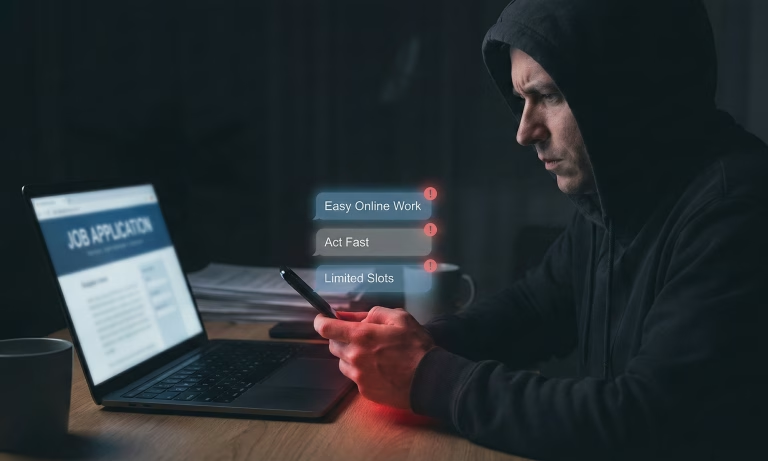
Recruitment often happens through trust:
- Friends
- Relatives
- Colleagues
- Community members
You may hear:
- “I’m already withdrawing”
- “Just start small”
- “I’ll tell you when to exit”
- “Don’t worry, you can stop anytime”
But here is the truth:
Your recruiter benefits when you deposit — not when you are safe.
They are not offering financial protection.
They are not acting as advisors.
They are participating in a system that rewards them for bringing you in, regardless of what happens to you later.
Trust Turns Small Risks Into Big Losses
Most people don’t invest large amounts because of a platform alone. They do it because they trust the person who introduced them.
That trust can push people to:
- Borrow money
- Use savings
- Increase deposits rapidly
- Ignore warning signs
When Solar Max collapses — as all such systems do — it is not the early recruiter who absorbs the damage.
It is the people who joined later, believing they were being helped.
“I Made Profit” Does Not Mean No One Was Harmed
Some participants justify involvement by saying:
- “I already got my money back”
- “I only invested small amounts”
- “I didn’t force anyone”
But Ponzi-style systems do not create money.
Every rupee withdrawn comes from someone else’s deposit.
If you profited, it means others will not — and statistically, many more people lose than win.
There is no harmless participation.
How Profiting From Scams Helps Scams Grow
Money lost in one scam rarely disappears. It is often:
- Recycled into new schemes
- Used to fund similar platforms
- Reinvested into more advanced fraud
By recruiting others — even “just to earn while it lasts” — participants are not taking money from scammers.
They are feeding the ecosystem that allows scams to evolve, replicate, and spread.
Each new deposit:
- Extends the scam’s lifespan
- Strengthens its infrastructure
- Encourages copycat platforms
This is how scams grow larger and more damaging over time.
Why Solar Max Will Collapse Suddenly
Schemes like Solar Max survive only while new deposits exceed withdrawals.
Early payouts create confidence.
Screenshots circulate.
Recruitment accelerates.
Then:
- Withdrawals slow
- Excuses appear
- Limits change
- Support disappears
Collapse is not gradual.
It is abrupt.
The Real Risk to Sri Lankan Consumers
If you deposit money into Solar Max:
You are not renting solar panels.
You are entering a redistribution chain.
Your profit depends entirely on someone else depositing after you.
When that stops, someone is left holding the loss.
Final Consumer Warning
Solar Max is not a renewable-energy investment.
It is a short-term Ponzi-style scheme disguised as a green opportunity.
Early payouts do not equal safety.
Professional design does not equal legitimacy.
Solar branding does not equal real solar activity.
If you are considering joining — pause.
If you are already involved — do not escalate your exposure.
Awareness is protection.
And protection always costs less than regret.
Stay Sharp. Stary Safe. Stay HackAware.
– DEBUGGER